Friday, January 4, 2013

92---5 Star Rating on Cabela's Dryplus Waders


Guys I got two fly fishing reviews that I want to share with you. I am in the hunt for a new pair of waders, which don’t cost through the roof, but yet will take the wear of a day’s fishing. I think I found the wader in Cabela’s Dryplus Prem Chest Waders. I was really impressed with triple layer knees and the fact that they don’t fit loose to the point where they are baggy. The review on these waders are astounding with 144 reviews resulting in 92 –5 star---36 –4 star—6—3 star and only 6 ---1 star.

 Another item some you guys might be interested in is the new Tenkara Temple Fork Fly Rod in 10 and 11 ft. I recently had a chance to actually get a feel for this rod the other day when I was visiting Riverside Fly Shop located off the tailrace at Smith. It was the first chance for me to pick one up and I have to say I was impressed. The lightness and the sensitivity of these rods are astounding. I am still in the thought stage as to purchasing one.

The generators are running continuous at the lake now and fishing below the tailrace is too dangerous for wading. Randy at Riverside told me the other day that there were 1500 rainbow ranging from 12 to 15” released in the tailrace the other day, so I may get to connect with one soon, once the water levels get back to normal. One of my main objectives this year is to fish the tailrace much more as opposed to last year.

Saturday, December 29, 2012

Fly Fishing Streams in Mississippi


I use to fish sparingly with the fly rod back during my early days in Mississippi. I was too busy fishing my bait casting combo for largemouth bass mostly from my small aluminum boat. Little did I know that when I lived there that there were 100’s of small streams in the state that was a fly fisherman's dream. This fact really hit home the other day when I was reading the Outdoor Sports section of the Clarion Ledger the largest newspaper in Mississippi. Rex Jones a documentary film maker at Ole Miss had put together a fantastic piece on fly fishing streams in Mississippi. The documentary features David Frazier an avid warm water fly fisherman who has fished some of the best streams in the state for bluegill, spotted bass and largemouth bass. After watching the video, I discovered I missed out on some great stream fishing using the fly rod in Mississippi when I lived there. Hope you enjoy the video much as I did; it is worth the watch.


Sunday, December 23, 2012

Interchanging Fly Line Weights With Fly Rod Weight


I started experimenting towards the end of the fishing season last year with interchanging different line weights with the fly rod weight. I did this because at times fishing the tailrace I experienced lots of wind in some of the narrow areas. I started using a 5 weight line with my 4 wt fly rod to help cut through the wind a little better. I found the exchange made it much easier to cast and place the fly with more accuracy. I also discovered that with the wind ripples on the surface I didn’t need the longer leader in the 9 -10ft. range; I could actually fish a 7 ½ ft. leader and get even more accuracy. So hopefully I have the wind problem solved when it is whipping down the gorge at break neck sped.
 After trying the “wind scenario” and it proving to be successful; my next experimental pairing will be to use 2 or 3 weight line with my 4 wt 8 ½ ft. fly rod. With this pairing I still have the power in the rod, but I am getting a much softer and lighter presentation of the fly as it touches the surface. Using a 9 to 10 ft leader/tippet size will cause even less disturbance on the surface. The trout here experience a lot of fishing pressure and I feel the lighter the better for me when it comes to producing a take on a tiny dry or nymph. This will be my first set-up I will be experiment with when I get back on the water. I know a lot you guys have interchanged lines with rod weights; what’s your take on line weight verses rod weight?
 
Hope all you guys have a great Christmas!!!

Sunday, December 16, 2012

Viewing the Mico Nymphing Technique--Interesting!!


I have to admit trout fishing or any kind of fishing is put on the back burner during this time of year for me. The tailrace will be up and going again sometimes this month. There will be 3000 rainbows released right below the dam in the coming weeks. These trout will be coming from Missouri and will be larger than the 9-10" trout we get from Tennessee. I hope to be on the water as soon as the trout get accumulated to the surroundings. In the meantime I fill the days going to the gym, removing tons of leaves in the yard, visiting our children and grandchildren and watching lots of fly fishing videos clip on YouTude. While scanning the tube yesterday I came across this neat little piece of footage I thought was really interesting. It is called “Micro Nymphing” the guy gives an excellent presentation on this nymphing  technique. I learn something every time I watch one of these clips; I hope you learn something as well.


Sunday, December 9, 2012

Converting a Good Trout Stream Into an Excellent Trout Stream


Guys I wanted to share some of the good things that are happening on our tailrace below Smith Lake. There is a mile stretch that Alabama Power is making improvements on. It will give the area a Western look with all the pebbles and boulders they are adding. A lot of the water on the stretch has been diverted to create some natural looking seams, deep runs and fast water with less depth. The improvements were drawn up by the Southeastern Engineering Stream Improvement Firm. Trout Unlimited and the Riverside Fly Shop which is located on the tailrace worked closely with the Engineering group. The results have been spectacular as far as this area is concerned for trout fishing. The following images below can give you some insight into the work that has been done. All of the improvements for this area should be finished by the end of January. The work on the next two mile stretch will begin next fall below the pump station. After that completion there will a little over 3 miles of Western style trout fishing here in Jasper. Think of the revenue that can be produce for this cash striped county.
One will have much more room for the back cast now
Notice the large rocks that have been added
There is very little water that is flowing while all this work is going on.
This image was taken after they completed this area, the water was shut down the next day to start work above this area--can't wait to fish this place!!
Some of the smaller rocks that are being place in the stream bed.
Here is another area that is complete, a lot of rock broaders are being used
Finished stream that has been narrow with depth and underwater logs
Huge boulders at the edge of a deep hole with underwater logs--this should be a great area
This area use to be extremely wide and shallow; it is half the that size now
A little creek area flowing into a small pool which opens up at the other end--interesting place to fish for trout

Sunday, December 2, 2012

An Awesome Gift From a Fly Fishing Buddy


I have to admit that I am a little behind on my blogging. Reading my new fly fishing book, which one of my fly fishing buddies gave me has limited my blogging time. It is the type book one picks up and just can't put down. The book "The Complete Book of Flyfishing" has to be the total package when it comes to flyfishing. It covers everything from the evolution of flyfishing to small streams, saltwater, salmon and sea trout. I must admit that I am not into the saltwater scene, but it did have some interesting techniques for streamer fishing. The section on insects, equipment, and still water fishing is outstanding. The illustrations and images are extremely vivid and detailed.  One thing that got my attention from the start of the read was when and where flyfishing got its start. I never realize that the first literary description of flyfishing comes about in the year AD 200. Remarkable that this great sport we all have come to love started that far back. I found out that one can never learn everything about flyfishing and this book proves it. The image below gives you some insight into the research and authors who contributed to this "Encyclopedia of Flyfishing". I am sure some of you guys out there have heard or even read this book, but for those of you who haven't had the pleasure; it is worth the read on those days you can't get out on the water.   
 
A sidenote here: Am I the only one having trouble loading my post on Outdoor Blogger? I have just about given up on uploading post there. I usually get this message "error timed out" --can someone tell me what I am doing wrong?

Friday, November 23, 2012

Exploring the Natchez Trace Parkway in Choctaw County


Road trips are the best way to discover new areas and to see some things that just might perk your interest. I made one such trip a while back with my brother Bobby to an area off the Natchez Trace Parkway. If some of you haven’t heard of this stretch of highway; then you are missing a famous roadway that runs through Mississippi, Alabama, and Tennessee. The Trace covers 444 miles through these three states. The first travelers on the Trace were European Explorers as far back as 1742. The Trace during that time was known to be a dangerous place to travel with robbery and killings common. Even Meriwether Lewis lost his life while traveling the Trace.

My brother and I spent the better part of the afternoon at the tiny town of French Camp which is one of the many historical sites along the Trace. The little town is located 82 miles south of Tupelo Mississippi. While there we drove through the campus of French Camp Academy, which is actually a Christian Boarding School for trouble children. The School has made a tremendous difference in so many children’s lives over the years. The following projects are some of the astounding accomplishments that the children have completed while attending school.
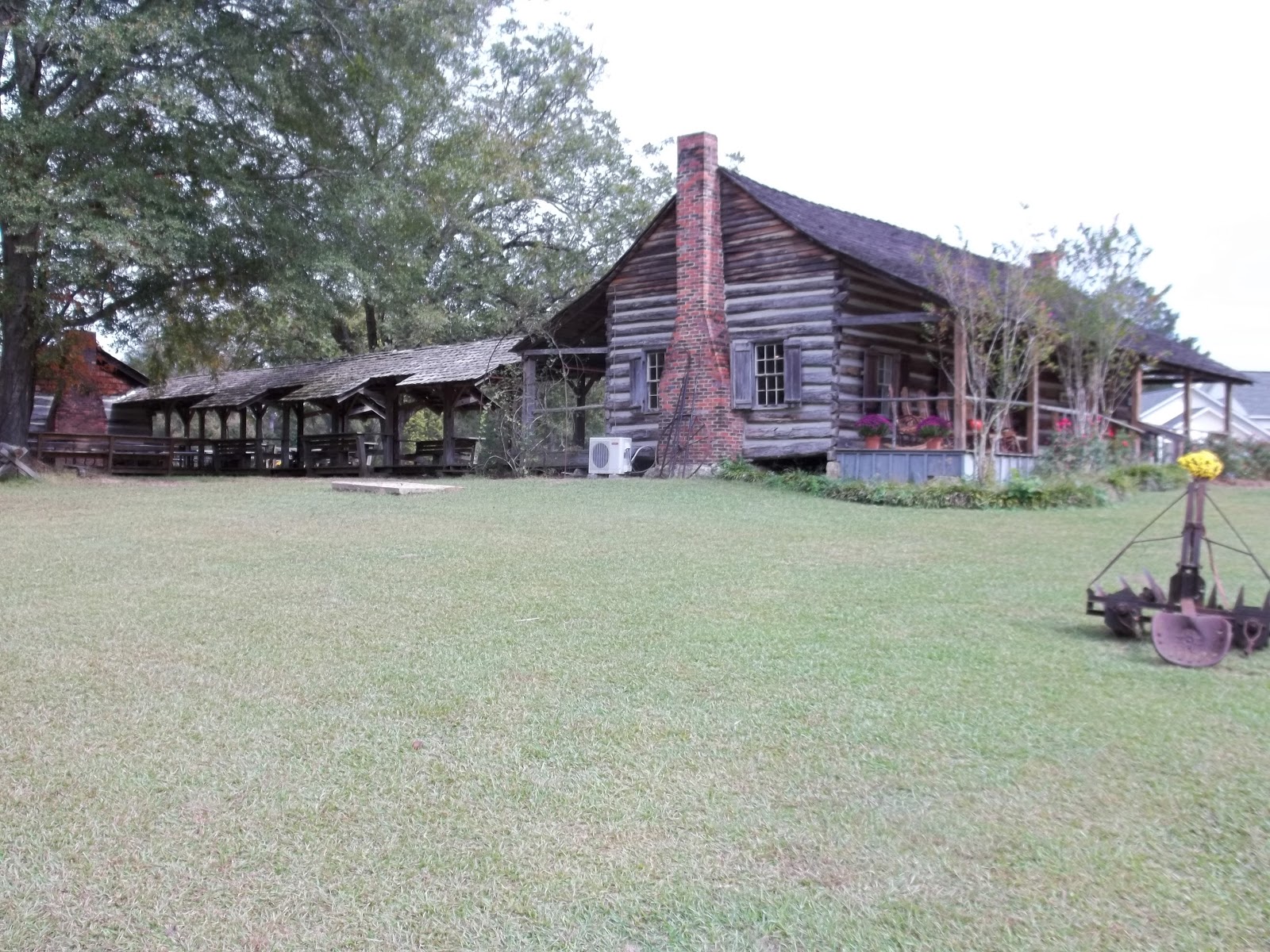
 This is one of the many dwellings that was moved from old homesteads throughout the area and reconstructed by the students at the school. Every board and log were moved and mark to duplicate the original dwelling. Even the original square head nails were used to complete the dwellings. This house at the entrance of the "Walking Museum" which is really what this is; is the welcome center with a gift shop which was a bedroom in this house and to the right across the hall is another bedroom.                                          
Another view of the welcome center with a walkway constructed by the students, which is leading you to the Cafe
This building is the cafe where they served some of the best bread pudding I have ever eat. The sandwiches were outstanding as well. They also make all their bread in the cafe which is sold in the gift shop. This exact spot was where the Choctaw Indians had their council dwellings. The Choctaws lived in this area.
   Construction of the Colonel James Drane house began in 1846 using a water-powered saw. This man was a prominent citizen back in the early 1800s in the French Camp area. The foundation and framing of the house are secured with wooden pegs and the ceiling with squared nails. Moved to this location in 1981, the house is now owned and operated by the French Camp Academy. This was the finest house in the area during that period. The house is listed on the National Registry of Historic Homes in the United States. The following is a description of the inside---  There were four principal rooms downstairs, two on each side of a large central hallway, faced with huge double doors but open at the back. The fireplaces in the two front rooms had matched mahogany mantels. A curved stairway led from the left rear of the hallway to three bedrooms on the second floor, two large wing rooms with three front windows each, connected by a small hall at the middle front window, opposite which was a small central room with a single-window opening on the back of the house. The house is fully furnished with period furniture.
 Sorry, I don't have a full view but there was so much reflection from the front until I had to settle for the back of Col. Dranes carriage.
The original old French Camp Post Office 1848.  
This old barn was moved from a nearby farm where the barn was the only building that was left. All the logs and boards were assembled using the original wooden pegs and square head nails. All the plows, harness, and gear are in the barn. This was really interesting in that it was assembled to perfection.
This is the shophouse on the early farm. This one building was ever so important to the function of the farm, because of the tools it housed to repair the farm tools. All the period tools are here in this dwelling.
This house was actually moved from an area north of French Camp--it was falling apart before it was rescued by the students at the school. All of the houses are original except the chimneys, they are all new.
I couldn't let this post go by without showing you some of the awesome looking streams that are found on the Trace. My brothers and I fished many of these streams as young boys back in the day. In fact, my brother and I were raised less than five miles from the Trace.
   One of the scenic waterfalls that are found on the Parkway.  Exploring the trace brings back so many memories of when our family lived here.